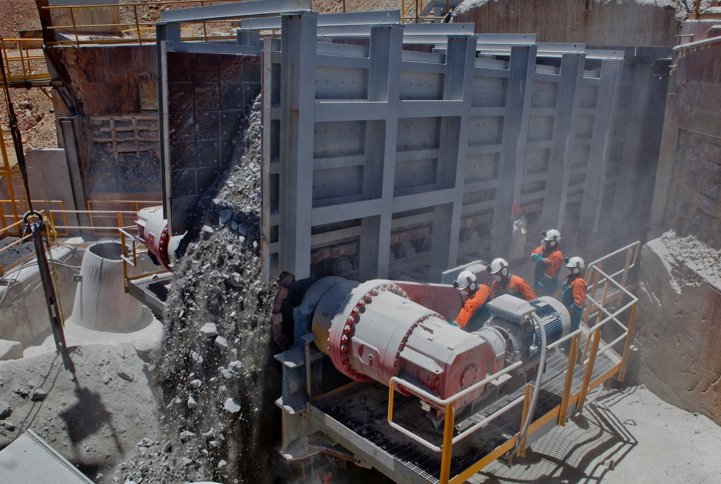
Apron feeder modernizations & upgrades

Focused on increasing availability, reliability, safety, ease of maintenance, and performance

Discover a wide range of upgrades, retrofits and refurbishments to simplify apron feeder maintenance and spare part requirements, and to boost apron feeder safety, reliability and performance.
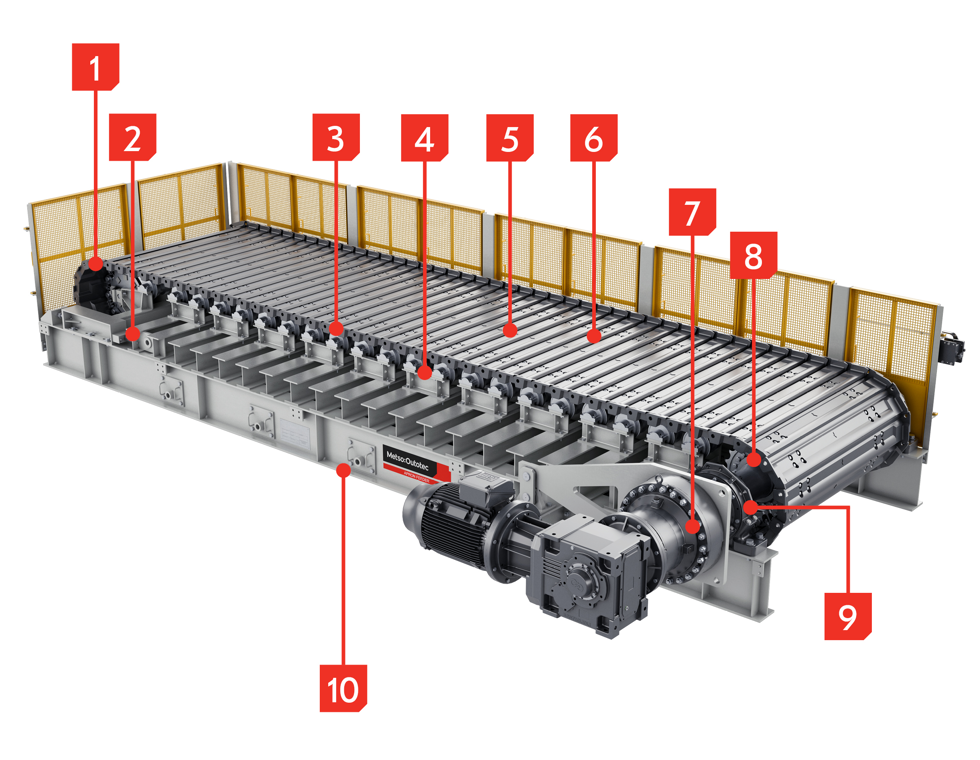
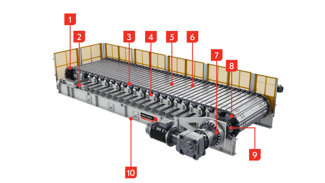
Rendering of a Metso apron feeder with number callouts

Apron feeder modernization and upgrade options

1. Tail wheel assembly

Many existing and older apron feeders are challenging to service, need regular lubrication and often involve the manipulation of large and cumbersome shafts during changeouts. Metso can provide an upgrade to the tail wheel assembly that does not require a shaft or outboard pillow block bearings to lubricate. The new ‘shaftless’ modular design features a tail wheel that rides/wears on the bottom of the chain so there is no contact between the bushing of the chain and tail wheel. Besides eliminating the tail shaft and bearings, the tail wheel assembly does not require regular lubrication since the wheel is sealed-for-life lubricated.

Benefits of tail wheel assembly upgrade:

  • Shaftless design for simplified maintenance
  • Faster and safer changeouts
  • Sealed-for-life lubrication

1. Tail wheel assembly

Many existing and older apron feeders are challenging to service, need regular lubrication and often involve the manipulation of large and cumbersome shafts during changeouts. Metso can provide an upgrade to the tail wheel assembly that does not require a shaft or outboard pillow block bearings to lubricate. The new ‘shaftless’ modular design features a tail wheel that rides/wears on the bottom of the chain so there is no contact between the bushing of the chain and tail wheel. Besides eliminating the tail shaft and bearings, the tail wheel assembly does not require regular lubrication since the wheel is sealed-for-life lubricated.

Benefits of tail wheel assembly upgrade:

  • Shaftless design for simplified maintenance
  • Faster and safer changeouts
  • Sealed-for-life lubrication

3. Chain

Chains on older model feeders can often become contaminated with dirt or experience lubrication issues leading to premature wear. Upgrades can be made utilizing a SALT (Sealed And Lubricated Track) chain, which features a better seal system, oil lubrication and more flexible links for less power consumption.

Benefits of chain upgrade: 

  • Improved wear resistance
  • Reduced power consumption

4. Carry (top) rollers

When servicing the top carry rollers of older apron feeders, replacing the complete assembly can be a challenge. Metso offers an upgrade, featuring heat-treated, forged alloy steel top carry rollers that are hardened for long rim-wear. These also feature a modular design, which allows the rollers to be easily removed without having to remove material from the feeder or lift the chain from the rollers. The rollers are sealed and lubricated for life with high load-carrying capacity bearings that ensure trouble-free service.

Benefits of top carry roller upgrade:

  • Modular design for simplified and safer maintenance
  • Lubricated for life

5. Pans (flights)

Cast steel pans often experience severe wear during day-to-day operation, becoming thin or even flexing, which can cause lengthy downtime to service. Metso can upgrade pans to cast manganese pans, which can be ‘work hardened’ to achieve up to 500 Brinell, perfect for high-impact loading and abrasive operations. The pans are cast from high-quality austenitic manganese steel with a stiffened underside for additional strength. A longitudinal center rib provides close tolerance to impact rail(s) under the deck, thereby preventing excessive deflections.

It is strongly recommended to also replace the impact rail(s) when changing the pans, to ensure proper clearance between the pans and the rails.

Benefits of manganese pans upgrade:

  • Increased durability for high-impact operations
  • Reduced downtime required for maintenance

7. Head shaft and main drive system

Apron feeders are high-torque low-speed applications, and older models use multiple reducers, chain and sprocket sets, open gearing, countershafts, etc., to achieve the necessary mechanical advantage. With so many moving parts, spare parts inventory requirements are high and need constant lubrication and care. Older parts often become obsolete and difficult to source.

Metso’s current drive design minimizes the number of parts by utilizing a single, compact multi-stage planetary reducer to drive the head shaft. With spare parts readily available, the customer no longer needs to rely on makeshift solutions to replace obsolete parts.

The new design does not require mounting to the customer’s floor steel, since the reducer is mounted directly to the head shaft by a locking device connection and torque arm that connects to the feeder frame.

As part of the upgrade, the head shaft assembly including the bearings will be upgraded. Along with simply modernizing the drive system for the same capacity, Metso can also convert hydraulic drives to electromechanical (and vice versa) as well as upgrade drives for additional throughput.

Benefits of head shaft and main drive upgrade:

  • Lower maintenance, encapsulated systems requires less lubrication
  • Minimized spare parts inventory
  • Potential for significant gains in throughput
  • Reduced lifecycle costs through improved reliability
  • Smaller footprint by removing large outdated components
  • Improved energy efficiency

8. Drive sprockets

Older drive sprockets consisted of a single-piece design that is difficult to change out, resulting in excessive downtime. Metso's upgraded drive sprocket design features three cast manganese alloy steel segments that allow replacement of one segment at a time, without needing to dismantle the feeder or remove the chain, pans, skirts and material on the feeder.

Rather than taking multiple shifts to change out the drive sprockets, the upgraded design allows a changeout in just hours. In addition, a half-tooth design with an odd number of teeth is used to allow contact with the chain during every second revolution, which doubles the life of the sprockets.

Benefits of drive sprockets upgrade:

  • Minimized downtime with faster changeouts
  • Simplified and safer maintenance
  • Doubled life of sprockets

9. Head shaft bearings

Older head shaft bearings can come out of alignment as they experience wear, causing stress on the machine. Head shaft bearings are often included when the drive and shaft assembly are refurbished. Upgraded head shafts are mounted on large, double-row, self-aligning spherical roller bearings, selected to provide long life to minimize maintenance requirements and downtime. The bearings are mounted in cast steel housings and fitted with dual purgeable (Taconite-type) seals for use in extreme conditions. These upgrades can help push the expected bearing life up to 100,000 hours, depending on site conditions, nearly double that of older models.

Benefits of head shaft bearing upgrade:

  • Improved availability and reliability
  • Extended bearing life 
  • Minimized maintenance requirements and downtime


10. Return (bottom) rollers

When servicing the return carrying rollers of older apron feeders, replacing the complete assembly can be a
challenge. Older designs commonly use single-channel support with double-flanged rollers bolted on both the inner and outer sides.

Metso’s upgrade features heat-treated, forged alloy steel return rollers that are hardened for long rim-wear. The rollers have a modular structure and are lubricated and sealed for life. Metso can provide a hinge design, which also improves safety while handling.

Benefits of return carrying roller upgrade:

  • Better service life and reliability
  • Reduced downtime
  • More efficient maintenance with reduced cost
  • No lubrication required
  • Minimized spare parts inventory

Safety accessories

Apron feeders can often be found in tight quarters, which can present safety issues and pinch points for staff working with the machines. Metso offers a variety of safety solutions that help keep your personnel safe. Safety guards can be installed to restrict personnel from entering into contact with moving parts of the feeder. Guards are engineered to meet the local safety and customer requirements.

Removable tail guards can also be retrofitted to older feeders, as well as removable side nip guards. Drive guards are also provided with all new upgrades. Emergency pull cord switches can offer peace of mind, allowing quick stoppage of the feeder in emergency situations.


Benefits from safety accessories: 

  • Improved overall safety 
  • Enforced local and customer safety requirements
  • Quick response in emergency situations

Many legacy brands, all supported by Metso

Metso is the sole owner of the original drawings and product specifications to previously sold OEM brands. In addition to Metso equipment, we own the drawings for brands such as:

  • NICO
  • Svedala
  • Stephens-Adamson
  • Faco
  • Allis-Boliden
  • Allis-Chalmers
  • McNally-Wellman
  • Nordberg

*Also available for select non-Metso equipment

Your information is safe. Check our privacy notice for more details.
Thank you!
We will shortly contact you. You can send a new inquiry again after 15 minutes.

Expert tips and resources to help improve apron feeder performance
Webinar
{{ title }} Overcoming common apron feeder bottlenecks with Metso expert Martin Yester
Aggregates
Mining
Customer case
{{ title }} Kinross replaced apron feeder pans with an optimized Metso technology and increased capacity by 20%
Mining
Metals refining
{{ title }} Metso apron feeder upgrades and services for mining applications
Digital tool
{{ title }} Increasing the efficiency of your project with immediate access to STP, DWG, and General Arrangements for Metso's apron feeder solutions
Mining
Blog
{{ title }} Feeding the facts: 1/3 apron feeder basics
Mining
Blog
{{ title }} Feeding the facts 2/3: Proper sizing and selection of your apron feeder
Mining
Aggregates
Blog
{{ title }} Feeding the facts 3/3: Apron feeder installation and management
Mining
Metals refining