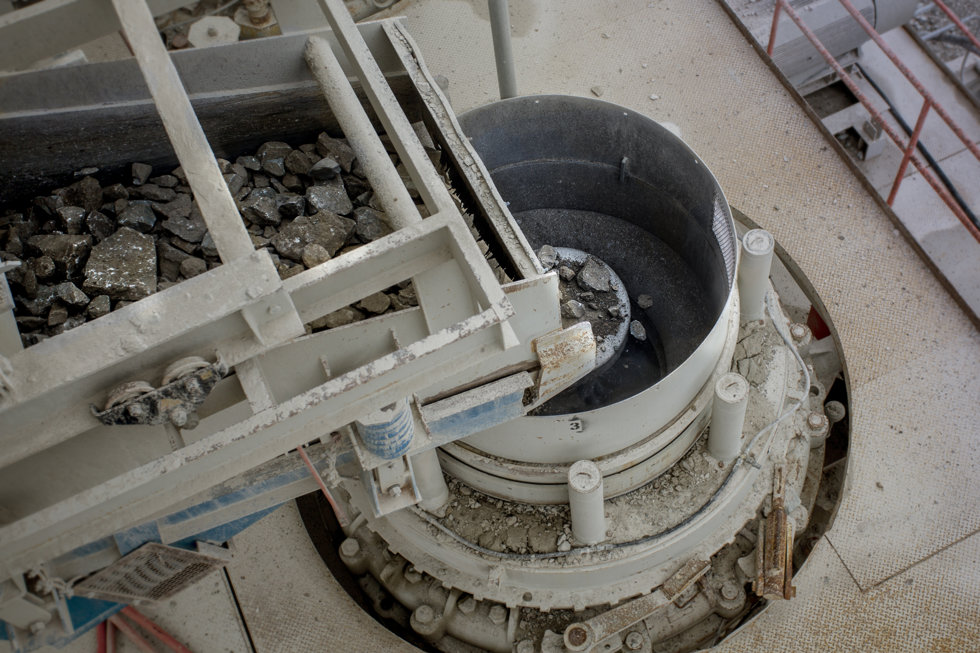
When in operation, the cavity filling level inside the crusher is an important factor for both production performance and operating costs. However, it should be noted that dust in the air and the difficulty in positioning a sensor to focus a beam down into the cavity can impact this measurement.
Whether a level sensor was not included with the equipment or if it is disengaged, not having an adequate reading on cavity level will almost always restrict optimal performance. A basic ultrasonic sensor has been effective in many installations but might have issues with airborne dust or getting a focused beam. Radar or laser/lidar sensors are often recommended today and have proven to be a more successful option that should be considered.
Another measurement specific to pedestal-shaft cone crushers is adjustment ring lift (also known as ring bounce), which is indicative of an over-force event that exceeds the crusher’s design rating (or less often, a loss of hold down force in the tramp relief system). Tens of thousands of cone crushers, both old and newer models, have no direct measurement of this critical condition. Instead, plant personnel are relied on to manually ‘hear’ any ring bounce. The issue with this strategy is that cone crushing is loud by nature, and it is easy to mistakenly “hear” ring bounce. Others may inadvertently dismiss actual ring bounce as “just how the crusher sounds”. Perhaps you are one of those veteran crusher operators that is nodding along here.
Accelerometers have been used for decades to monitor this critical condition. However, they require careful calibration and essentially are reading total movement of the adjustment ring, not its lift relative to the mainframe. More modern solutions use vibration frequency spectrum, magnetic positioning, and laser sensors, which have been proven effective at capturing ring lift events, with continued testing expected to reinforce confidence of these as long-term solutions.
#4 - Incorrect protection logics
Sensors, as outlined above, give the status of the condition being monitored. They are data points read or recorded, but by themselves do not trigger an action. That brings us to the next common issue today: incorrect equipment protection.
This ranges from protective interlocks (such as tripping the crusher feed when the discharge conveyor is stopped) and fundamental protection of the crusher (for example, tripping the drive motor if the lube pump(s) is turned off) to more system-related functions such as sequential start and stop sequences of the plant.
At the design and installation phases, the control logic and interlocks should be fully tested “offline” and validated. However, sometimes items are missed or, more commonly, modified or bypassed in the name of “just getting it to run” in the commissioning or ramp up stages. Even rudimentary mistakes like mismatched units of measurement can be seen. An example of this would be reading the temperature in Celsius then using protection logic stating degrees in Fahrenheit.
However, perhaps the most common mistakes related to protection logic of modern cone crushers are in the protection for over-power situations – not properly addressing over-power, using the wrong value for mechanical rated crusher power, and under-protective logic that allows the crusher to operate at excessive loads for excessive time. On the flip side, over-protective logic that causes an alarm and trips the feeder, or even worse, trips the crusher itself before it should be tripped can also be problematic.
Crushing by nature results in erratic mechanical loads on the crusher and the protection logic based on power draw should be based on the mechanical rating of the crusher at its configuration, the mechanical output of the drive motor and preferably a scale that triggers the alarms based on both the magnitude of the overload as well as a time factor for how long the overload is being accumulated. This logic should be attainable from the crusher manufacturer.
#5 - Treating all cone crushers the same
Though there are some fundamental rules that are universal for most cone crushers, the sizing, selection and operation of a particular crusher can vary significantly. As cone crusher technology has evolved from early Symons® and Hydrocone designs to modern cones with more aggressive kinematics and higher power ratings, operation targets should also evolve to keep pace.
A good example is the product size produced in relation to the Closed Side Setting (CSS) of various cones: for a Symons 7’ SH crusher, to achieve a P80 of 13 mm it would be typical to set the CSS near to 10 mm, while for a modern MP1250 SH crusher it has been able to achieve this same P80 at a CSS of 14-16 mm due to the higher interparticle/packed-bed crushing action of the high throw machine. On the other hand, some crusher models are more forgiving to conditions such as trickle-feeding and it is good practice to not assume what is acceptable with one machine is a given for another.
#6 - Breaking the mentality of ‘set-it-and-forget-it’
A crusher may seem simple, but modern cone crushers have many metaphorical (and some literal) knobs and levers that can be adjusted to achieve higher performance and reliability while minimizing operating costs. Unfortunately, many sites operate a particular crusher for years with no process optimization evaluation or adjustment.
Early in the life of a crusher, it is common that the protection and control logic set points are simply kept as ‘default’ values. In other cases, the protection/control set points are adjusted by a qualified person early in the plant operation when the ore being processed is not representative of future operation.
Even for a plant that has operated for years, there will almost always be changes to rock and ore properties, production targets, and equipment/plant configuration. A basic example would be a change in crusher liner profile to a finer or coarser chamber, which will change the relationship of the cavity level to the power and force loadings and should trigger a reevaluation of the CSS and feeder control targets.
#7 - Sub-optimal crusher liners
While the alloy or thickness of the working wear liners (mantle and either the bowl liner or concave, depending on cone type) is always a target to extend lifetime of the liners or evaluate total cost per ton processed, the geometry or profile of the liners is frequently found to be sub-optimal. In some cases, the geometry promotes peak loads in the chamber that restrict performance and elevate risks of mechanical issues; this is usually the case when the chamber profile is overly large/coarse for the application.
Other cases find the production ability of the cone crusher limited by an overly restrictive chamber. This is usually the case when the chamber profile is overly small/fine for the application. Not to complicate the matter, but the optimal chamber profile is also a function of the eccentric speed used on the crusher, which for modern crushers is a variable and needs to be vetted along with the profile. Optimizing the chamber profile has increased the production of a cone crusher by up to 20% or more, and this level of improvement has been achieved in more cases than one might expect.