Mining
Mar 23, 2026

Smarter grinding: How advanced modeling helps mines reduce energy and improve performance

Michael Denzel
Michael Denzel
R&D, Stirred Mills
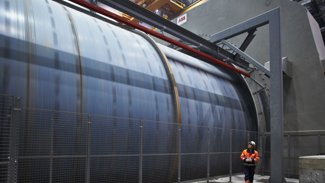
Grinding is one of the most energy-intensive processes in mineral processing. At many mine sites, comminution can account for nearly half of total electricity consumption, making it a major contributor to both operating costs and environmental impact. As ore bodies become more complex and operations require finer particle sizes to liberate valuable minerals, improving grinding efficiency has become increasingly important. By optimizing how grinding circuits operate, mines can reduce energy consumption, lower costs, and support more sustainable production.
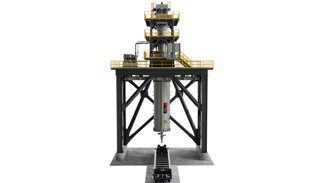
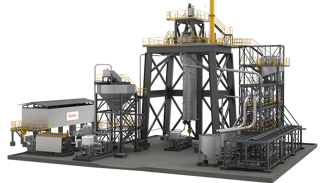
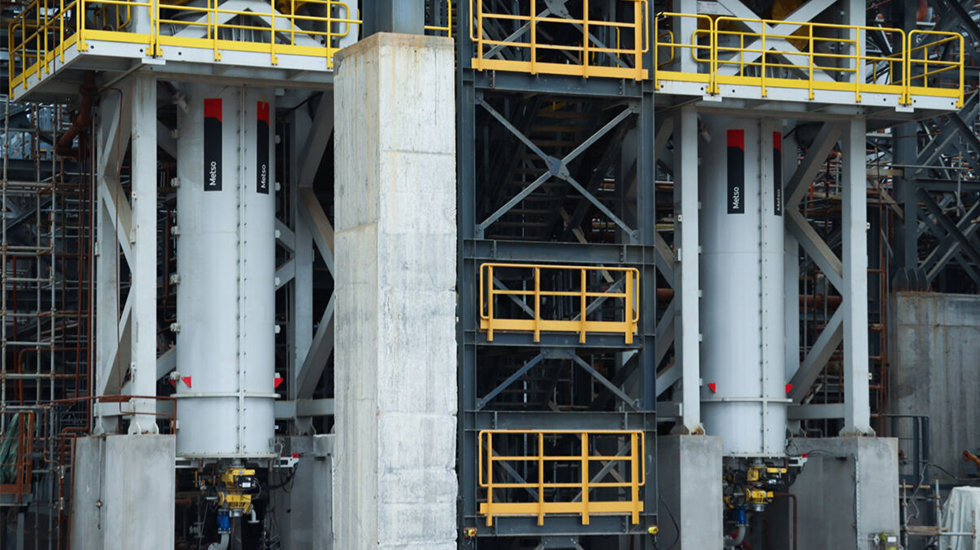
Metso HIGmill
Metso HIGmill

A more efficient approach to fine grinding

Technologies such as the Metso HIGmill part of the Metso Plus offering are helping operations address the growing demand for efficient fine and ultra-fine grinding. Unlike traditional tumbling mills that rely primarily on particle impacts, vertical stirred mills use intense shear and compression between grinding media to break particles more effectively. This mechanism allows energy to be transferred more efficiently to the particles that need to be ground, resulting in improved grinding performance while reducing overall energy consumption.

Understanding mill performance

Achieving optimal grinding performance depends on many factors working together. Variables such as grinding media filling level, shaft speed, slurry flow, rotor configuration, and ore characteristics all influence how the mill behaves during operation. Understanding the relationship between these factors is essential for improving efficiency, but testing every possible operating condition in a physical plant or pilot facility can be costly and time consuming.

Using digital simulation to optimize operations

To better understand mill behavior, engineers are increasingly using advanced digital simulation tools. By combining particle interaction modeling with fluid flow simulations, it is possible to create a virtual representation of the  milling process. These models simulate how grinding media move inside the mill, how slurry flows through the grinding chambers and how energy is transferred and distributed. With this insight, engineers can analyze how different operating conditions influence mill performance and identify opportunities to improve efficiency.
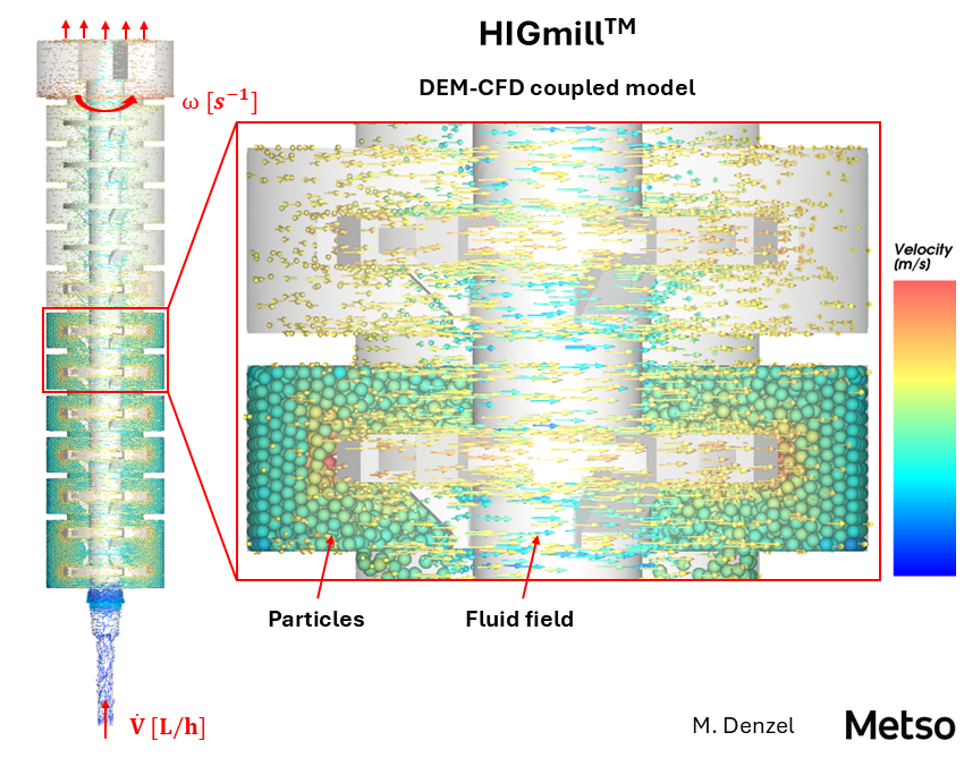
DEM-CFD coupled (1-way) model of 25L test mill with fluid visualized by a vector field

Why power draw matters

One of the most important indicators of grinding performance and efficiency is power draw. Power draw reflects the amount of energy required to  agitate grinding media and process material inside the mill. Understanding how power consumption changes under different operating conditions helps operators identify opportunities to optimize efficiency and avoid unnecessary energy use. Digital modeling allows engineers to predict how changes in variables such as shaft speed or media filling levels influence power requirements, enabling more informed operational decisions.

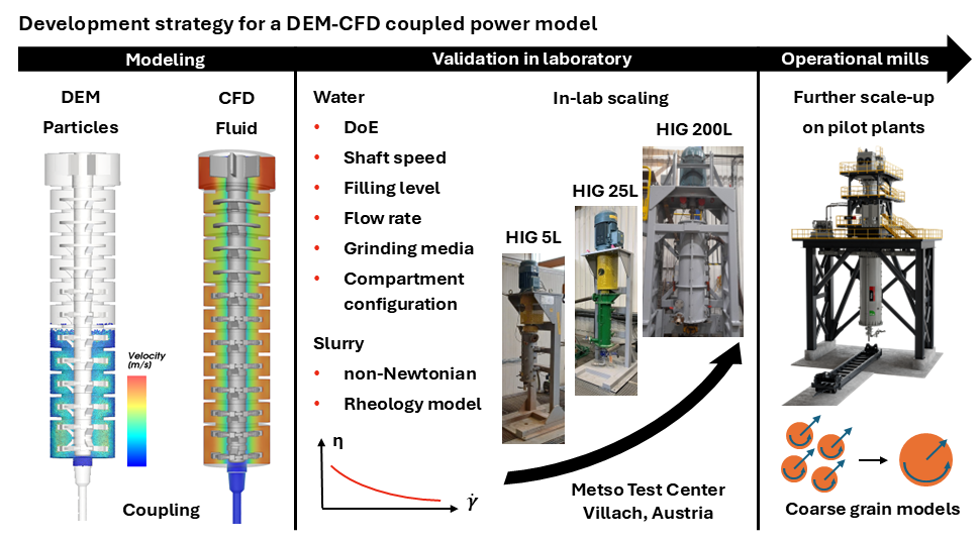
Development strategy for a DEM-CFD coupled model to determine power draw in vertical stirred mills

Improving maintenance and component life

Digital simulation also helps engineers understand how energy is distributed within the mill. In vertical stirred mills, grinding intensity is often higher in the lower grinding chambers, which can lead to uneven power distribution along the shaft and increased wear on certain components. By studying these internal dynamics through simulation, engineers can develop configurations that distribute the grinding load more evenly. This helps reduce excessive wear, extend component life, and support more predictable maintenance planning.

Supporting faster innovation and optimization

Another advantage of digital modeling is the ability to test new ideas quickly. Engineers can evaluate different rotor designs, grinding media sizes, and operating conditions in a virtual environment before implementing them in the plant. This significantly reduces the time and cost associated with physical testing and allows mines to adapt more quickly when ore characteristics or production requirements change.

Validating results with real-world testing

While simulation provides valuable insights, it must be validated with real operational data to ensure accuracy. Dedicated test facilities equipped with sensors measure key parameters such as torque, pressure, flow rate, and vibration during mill operation. These measurements are compared with simulation results, allowing engineers to refine and improve the models. Over time, this process creates reliable predictive tools that support both equipment development and plant optimization.

A smarter future for grinding

As mining companies continue to focus on efficiency, sustainability, and productivity, advanced digital tools are becoming an essential part of grinding optimization. By combining high-efficiency grinding technologies such as the Metso HIGmill with advanced simulation capabilities, operators can gain deeper insight into their grinding circuits. This enables smarter decisions about how mills are designed, operated, and maintained, helping mines achieve higher performance while reducing energy use and overall operating costs.


This expert blog is based on the whitepaper:

Development of a DEM-CFD coupled power model for vertical stirred mills

Michael Denzel, Fisher Wang, Alan Boylston, Ruari Soutar-Dawson

First published at 2026 SME Annual Conference & Expo

February 22-25, 2026

Salt Lake City, UT

Download whitepaper
Get your copy of the full whitepaper here
Enjoyed this article? Try this next
HIGmill energy efficient fine grinding
Read a research work conducted on the Outotec HIGmill® grinding rotor design, and learn why the HIGmill is positioned as the most ...
Read more
Mining