Mining
Published Jul 14, 2026

Is your system optimized or just its parts?

Bulk materials handling operations are under increasing pressure to deliver more with less. A smarter operating model can help unlock new levels of performance in this increasingly complex environment.
image

Across many industries, pressure is mounting and demands keep growing, and bulk materials handling (BMH) operations are no exception to this trend. Teams are expected to increase throughput, reduce cost per ton, improve availability, manage risk, stabilize quality and respond faster as conditions change. At the same time, they are being asked to deliver these gains with leaner crews, higher sustainability targets and a stronger focus on ESG (Environment, Social and Governance). 

The challenge is that most sites are already operating near the limits of their current operational model. In complex environments, performance is rarely constrained by the equipment alone. More often, the constraint determines how decisions are made, shared and coordinated across the entire system. That is where a smarter operating model can make a measurable difference. 

The real drivers behind world-class BMH performance 

When leaders in BMH talk about “performance,” they’re usually balancing several priorities at once: 

  • Throughput and asset productivity
  • Cost per ton
  • Availability, reliability, and uptime
  • Safety and risk reduction
  • Operational consistency and quality
  • Responsiveness and flexibility
  • Workforce sustainability
  • ESG, compliance and social license to operate 

These drivers are deeply connected. Gains in one area can create trade-offs in another unless the operation is managed as one integrated system.

Why full potential is seldom realized 

Even at well-run sites there are common limiters that prevent teams from operating closer to true capacity:

Human variability

Operational decisions are made by humans, in real time, in complex systems with incomplete information. Even experienced teams will make different calls under pressure and those differences add up. 

Poor system-level coordination

When different parts of the operation optimize locally, the system can still underperform. Bottlenecks shift, queues build, and real-time constraints move faster than manual coordination.

Slow recovery from disturbances

Disruptions are inevitable; weather, equipment behavior, logistics variability, vessel changes or material variation. The performance gap often comes from how long the system takes to stabilize after something unexpected happens.

Risk-driven conservative operation

Without confidence in operating limits, teams naturally leave buffers on the table. That protects the operation, but it also reduces throughput and increases costs. 

What high performers do differently   

Top-performing operations don’t just work harder; they change how the system runs: 

  • They optimize the system, not individual machines 
  • They remove human variability from critical decisions
  • They design for disturbance and recover quickly
  • They operate closer to safe limits with confidence 

In other words: they reduce uncertainty, increase coordination and make better decisions faster, especially when conditions change. 

A smarter way to run complex operations 

A smarter operating model begins with a shared operational picture, a single version of the truth that connects planning, execution and recovery. It enables the whole team to coordinate around the same constraints and opportunities, even as conditions change dynamically. 
This shift isn’t about replacing people. It’s about supporting them with real-time insight and decision-automation where it matters most, so that performance becomes repeatable, resilient and scalable.  

One integrated platform for end-to-end optimization   

To enable this kind of operational model, sites need more than point solutions. They need an integrated platform that turns data into coordinated actions across the whole bulk material handling value chain. 

Metso Axo33™ is a software platform that leverages sensor data and real-time insights to convert BMH machine resources into profitability drivers. Instead of treating equipment as isolated assets, the platform helps coordinate decisions across the system — connecting performance, safety and cost outcomes.

image
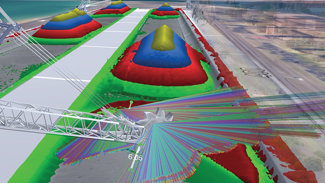
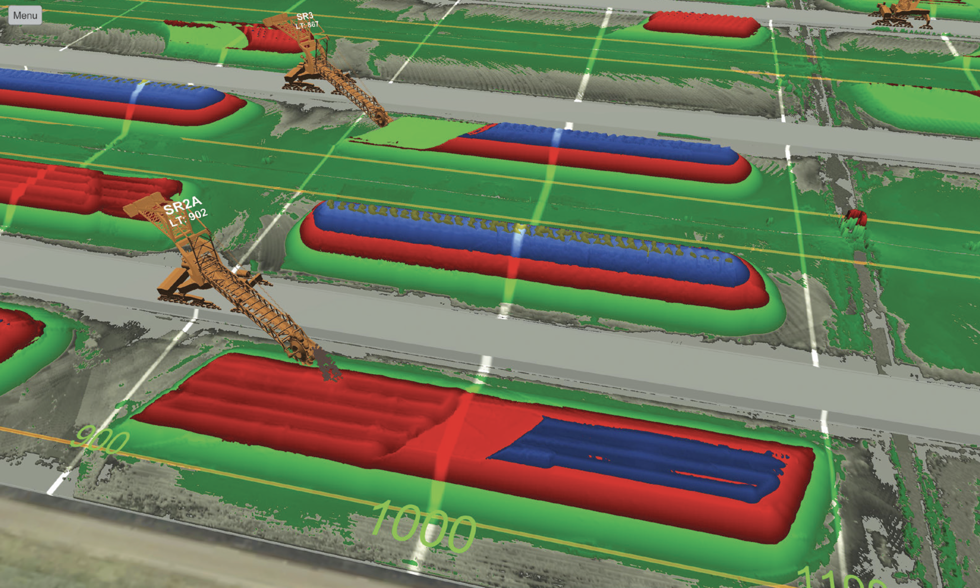
Metso Axo33™visualizes the stockpile in three dimensions and in real time using laser scanners. The figure above shows bench heights in different colors enabling customers to quickly view both stacking and reclaiming operations.

Measured impact: throughput, safety and cost 

When end-to-end optimization is applied in real operations, the results can really add up. Customer-realized outcomes include: 

  • Up to a 25% increase in loading rate from manually operated equipment 
  • Up to a 12.5% throughput improvement from semi-automated stacker-reclaimer optimization
  • Up to a 97.5% reduction in overload faults, contributing to longer asset life
  • Up to an 8% increase in train throughput
  • Over 5,000 vessels loaded incident free
  • Up to 99% accuracy in material grade control from stockyard to vessel 
These outcomes share a common theme: performance improves when the operation becomes more coordinated, more consistent and faster to recover, all without relying on heroics. 

Why customers choose an end-to-end approach 

Customers increasingly want a partner that can connect the full BMH stack, from physical assets through to electrification and instrumentation, to autonomous operations. 

This approach brings together: 

  • Mechanical and structural design, spares, optimization and service 
  • Electrical and instrumentation design, modernization, upgrades and automation
  • Automation technology that helps fully realize the potential of BMH operations 

When these pieces work as one, the operation can move beyond incremental improvements and unlock system-level value. 

A proof point: disciplined coordination at scale 

A strong example of what coordinated operations can deliver comes from Port Waratah Coal Services (PWCS) in Newcastle, NSW, Australia, the largest coal export terminal in the world. PWCS has built a reputation for disciplined stockyard coordination and ship loading, consistently achieving near-record throughput driven by operational consistency. 

The lesson is clear: scale doesn’t have to create chaos, as long as coordination is designed into the operating model.

image

A simple path to move forward 

Getting started doesn’t need to be complicated. A practical engagement path looks like this: 

  • Technical presentation and alignment 
  • Technical and commercial proposal
  • Site survey
  • Order placement
  • E&I (electrical and instrumentation) adaptation, upgrades and modifications as required
  • Software configuration and deployment
  • Commissioning 

This sequence helps sites move from initial alignment to deployed value in a structured, low-friction way. 

Closing thought: better outcomes come from better decisions 

BMH operations are complex, dynamic systems. The next step-change in performance won’t come from doing more of today’s operational status-quo, it will come from integrated smart solutions enabling faster, more consistent, system-level decisions, especially when disturbances occur. 

This smarter way of operating makes performance repeatable, safer, and more resilient, all while directly improving throughput, cost and operational confidence. 

If you’re looking to unlock more value from your bulk materials handling operation, speak to Metso about how integrated optimization and automation can help you move from local improvements to system-level performance.

Mining